
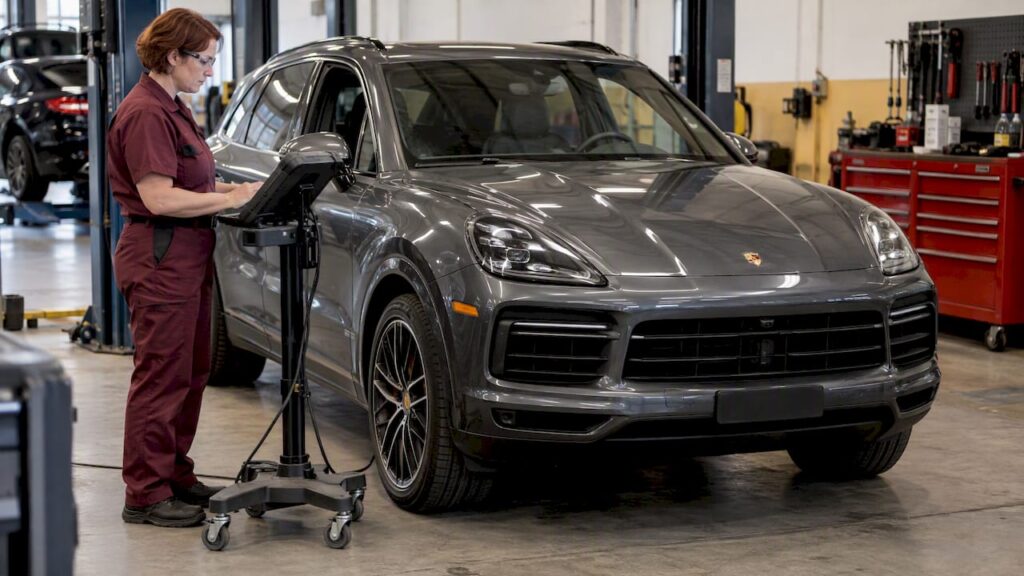
Adaptive suspension calibration teaches the car’s suspension control module what “correct” looks like after something changes. That means a new ride-height sensor, a replaced air spring or strut, a swapped control module, or a change in ride height. On vehicles with air springs, the same procedure is usually called air suspension calibration. It is done with a vehicle-specific scan tool on level ground, and skipping it can leave the car sitting low, leaning to one side, or throwing a fault.
This guide is for Dallas owners of European, luxury, domestic and performance vehicles with electronically controlled suspension. It covers what the procedure does, when it is required, what a proper job involves, and when the car should not be driven.
TL;DR
- Calibration sets the reference values the suspension computer uses for ride height and damper control. It is needed after certain parts or software changes, not after every repair.
- Whether a given repair requires it depends on the make, model and system. The factory service information decides, not a rule of thumb.
- A proper job needs the right scan tool, a level surface, correct tire pressures, an unchanged load, and measured ride heights at all four corners.
- A warning message, a corner sitting low, or a car that will not raise or lower means a diagnostic visit first. Calibration cannot fix a leaking air spring or a failed compressor.
- At Alternative European & Domestic, ASE-certified technicians diagnose first, then calibrate, so you pay for the repair the car actually needs.
Table of Contents
- What adaptive suspension calibration actually does
- When your car needs calibration
- What a proper calibration involves
- Why this isn’t a driveway job
- Warning signs to take seriously
- When not to drive, and when to tow
- What affects the cost of calibration
- Calibration and preventive maintenance
- Our approach in Dallas
- FAQ
- Sources
What adaptive suspension calibration actually does
An adaptive suspension changes how the car rides in real time. According to Counterman’s explanation of active suspension systems, the system takes inputs from ABS and stability control, body-movement sensing and suspension-movement sensing, then adjusts damper compression and rebound to suit.
Many of these systems also control ride height. VehicleServicePros reports that this is commonly done with air springs, though hydraulic versions exist. Its controllers combine data from accelerometers, suspension-position sensors, air-pressure sensors, steering position and other vehicle data.
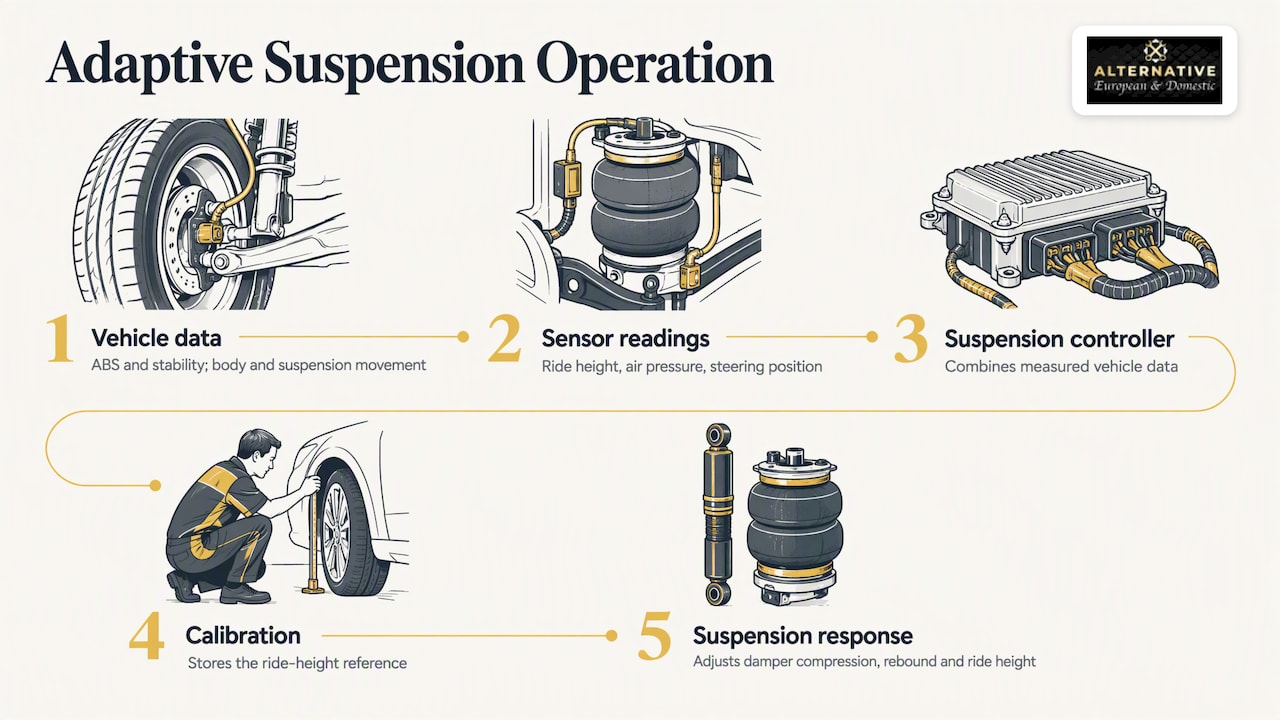
The module can only manage what it can measure, and every measurement is relative to a stored reference. Calibration writes that reference. Delphi describes air-suspension height calibration as establishing the correct ride-height reference after an air-spring or height-sensor replacement. If the reference is wrong, the car acts on bad information: it may sit a few millimeters off, lean, or hold a height that does not match what the sensors report.
Adaptive versus air: the practical difference
The two terms overlap, and that is the source of most confusion.
| System | What it controls | Typical calibration concern |
|---|---|---|
| Adaptive damping (electronic dampers) | Damper firmness through valves or magnetic fluid | Sensor and module relearns, damper or strut coding |
| Air suspension | Ride height and leveling through air springs | Ride-height reference at each corner |
| Combined systems | Both, common on premium vehicles | Both, often in a set order set by the manufacturer |
Many premium cars combine the two, so confirm which hardware your car has. The owner’s manual, the option codes tied to your VIN, or a quick look underneath will tell a technician which system applies. That determines the procedure.
When your car needs calibration
The honest answer is “sometimes.” Snap-on’s technical guidance on electronic air suspension repair and service functions tells technicians to consult vehicle-specific service manuals before assuming every repair needs calibration, because requirements vary significantly by make and model. The same page warns that treating a repair as finished once the part is bolted on can be a costly misconception, since the control system may still need an after-repair function.
In practice, these are the situations that most often call for it:
- A replaced ride-height sensor. Counterman notes that sensors can suffer damaged linkages or connectors, and that a replaced ride-height sensor must be calibrated after installation.
- New air springs or height sensors. This is the classic case in Delphi’s description, and some vehicles need a static calibration followed by a dynamic, road-based one.
- A replaced suspension control module. Some manufacturers require calibration here even when shocks alone do not. For example, DiagnostData’s procedures for the Land Rover Discovery L319 say shock replacement does not require it, while a new control module or height sensor does.
- Software or module updates. A 2021 GM service update covering certain Cadillac Escalade, Chevrolet Suburban and Tahoe, and GMC Yukon XL models found that incorrect calibration values in the vehicle leveling module could leave loaded ride height 0.6 inches below normal. The fix was module reprogramming by the dealer.
- Strut replacement on some models. For 2018 to 2024 Ford Expedition and Lincoln Navigator vehicles with CCD suspension, one parts publisher says an alignment is required after front strut replacement and calibration may be necessary.
- Changed ride height. Lowering springs or a coding change that alters the system’s configuration usually means the reference points must be reset.
Notice the pattern: the trigger is a part that measures, controls or defines height, not simply any part in the suspension. A technician working from factory procedures can tell you which applies to your car before the work starts.
Calibration, alignment and diagnosis are different jobs
Three things get mixed up at the counter:
- Calibration sets the system’s height and sensor references.
- Alignment sets wheel angles. Ride height changes alignment numbers, so after air spring or strut work the two are often needed together.
- Diagnosis finds out why the suspension misbehaves in the first place.
Calibration is never a diagnosis. If a corner sags overnight, the cause is a leak or a failing component, and recalibrating on top of it only hides the problem for a day. Our guide to leak-first diagnostics on Mercedes AIRMATIC systems explains why the order of testing matters and how it saves repeat visits.

What a proper calibration involves
Procedures differ by manufacturer, but the shape of a correct job is consistent.
1. Confirm the need and the fault status
A technician scans all modules, reads suspension codes and freeze-frame data, and checks live data from each height sensor. A car with an active leak, a weak compressor or a corroded connector is not ready to be calibrated. This is also where we separate suspension noise from height problems. If your complaint is a knock rather than a height issue, our shop tests for suspension clunks over bumps cover that path.
2. Prepare the vehicle
Delphi lists the conditions that apply before air-height calibration:
- The air system must be refilled to normal operating state.
- The vehicle sits on level ground.
- The steering wheel is straight.
- Tire pressures are set correctly.
- The load is unchanged, and occupants are out of the vehicle.
Manufacturer-specific weighting instructions can also apply. Professional procedures likewise call for a flat, level surface with no heavy objects inside. Uneven pavement or a trunk full of tools is enough to push a measurement out.
3. Measure ride height at each corner
Some systems ask the technician to measure and enter the height of each corner. A Bentley technical bulletin in NHTSA’s technical service bulletin library describes a procedure that prompts for each corner’s measured height, from the wheel center vertically to the center of the wheel arch.
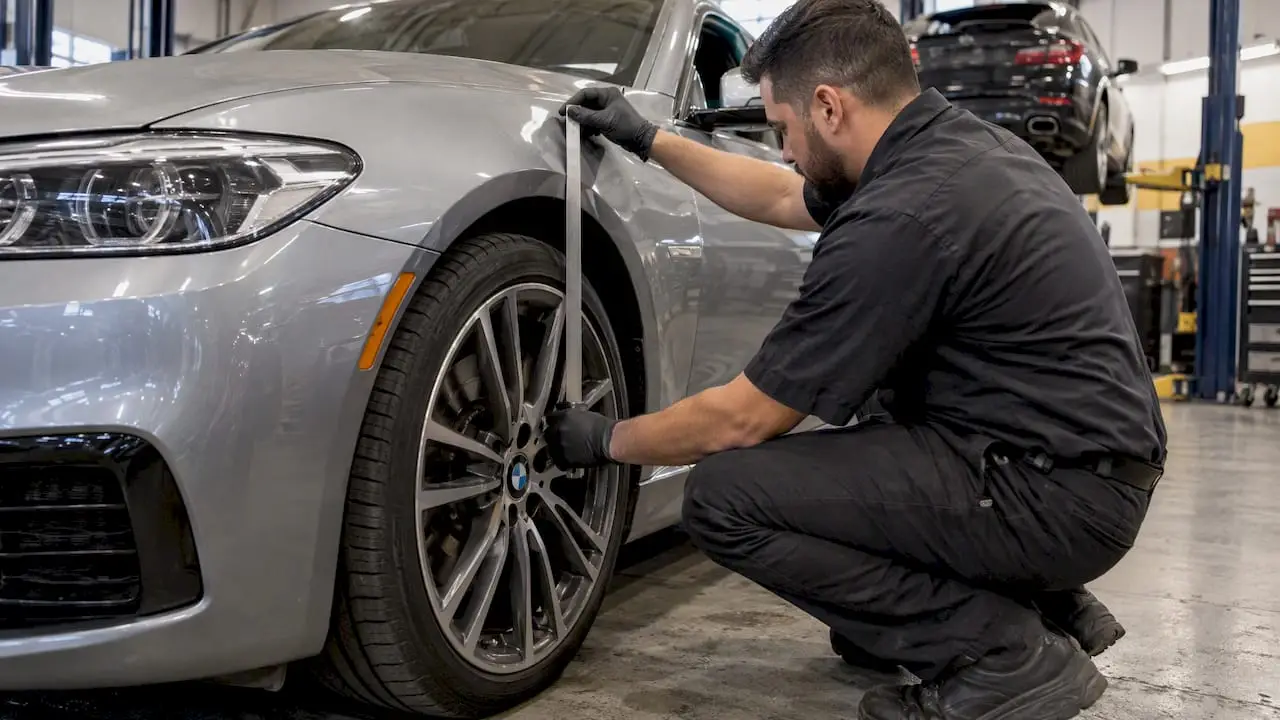
Other makers go further on the verification side. Tesla’s Cybertruck ride height calibration procedure has the technician confirm the chassis height measurement tool is zeroed at 51 mm, measure ride height at four points, and confirm the values are within 5 mm of specification. That is one vehicle’s procedure, not a universal tolerance, but it shows how exact the process is. A calibration done by eye is not a calibration.
4. Run the scan tool routine
The scan tool then walks the system through its learning cycle, raising and lowering the vehicle and storing the new references. Some cars finish here. Others require a dynamic step, a road drive under defined conditions, as Delphi notes for some vehicles.
The tool matters. A parts publisher’s guide to several Land Rover air suspension generations states that a generic OBD-II reader cannot reach the ride-level module, and that a Land Rover-specific scan tool is needed for diagnosis and calibration. The same principle holds across European brands: the suspension controller often sits behind manufacturer-level access that a basic code reader does not have. That is the practical value of dealer-level diagnostics at an independent shop.
5. Verify, clear and road test
After calibration, the technician rechecks heights, clears stored faults, confirms the system raises and lowers through its range, and road tests the car. Where ride height changed, the alignment is checked or reset. A good shop reports the readings in writing, which is the same habit we recommend in our list of questions to ask a mechanic.
Why this isn’t a driveway job
Owners often find forum threads and videos showing calibration with consumer scan apps. Some of those tools reach some modules on some cars. But the job involves working under a vehicle whose height is controlled by pressurized air and software. Raising or lowering a suspension while someone is under or beside the car is a crush risk, and lifting an air-sprung car incorrectly can damage the system.
There is also a quality problem. A calibration saved against a wrong reference does not announce itself. The car may feel fine, then wear tires unevenly, pull, or set a new fault weeks later. We do not recommend attempting it at home. If a warning is on your dash, a professional diagnostic evaluation is the safer and usually cheaper path, because the root cause is found before parts are replaced.
Warning signs to take seriously
These symptoms point to a suspension system problem, and calibration may or may not be part of the fix:
- A corner or an entire axle sitting visibly low, especially after the car has been parked overnight.
- Dash messages about suspension faults, ride height, or “vehicle too low.”
- The car refusing to raise or lower, or doing it slowly or unevenly.
- A compressor that runs far longer or more often than it used to.
- A harsher or floatier ride, or body lean in corners, after recent suspension work.
- Uneven tire wear or a pull after a ride-height-related repair.
Worn mounting hardware can mimic some of these symptoms. Our article on control arm bushing symptoms and when to drive or tow helps you tell the difference between a bushing problem and a system problem.
When not to drive, and when to tow
Suspension faults sit on a spectrum, and the safe call depends on what you see. These are general guidelines. If you are unsure, call a shop before you drive.
Usually fine to drive carefully to a shop:
- A suspension warning with the car at normal height and normal steering.
- A mild ride quality change with no noises and no height change.
Do not drive. Arrange a tow:
- The car is sitting on its bump stops, or a corner is sagging so low that a tire rubs the fender liner or wheel arch.
- You hear scraping or see tire contact with bodywork.
- Steering feels loose, the car wanders, or braking feels unstable.
- You see fluid, a hanging component, or a broken spring.
- The car is stuck in an extreme high or low setting and cannot be adjusted.
Towing costs less than a damaged wheel, tire, fender or control arm. Driving a car that is sitting on its stops can also stress other components and take away steering and braking margin.
What affects the cost of calibration
A single published price for calibration would be misleading, because the work varies so much. The factors that move the bill:
- System type. A simple height-sensor reset is a smaller job than a full air system with adaptive dampers on all four corners.
- What triggered it. Calibration after a sensor swap is one line on an invoice. Calibration after a leak repair comes with the leak repair.
- Diagnostic time. Finding why a corner sags, a compressor overworks or a sensor reads wrongly often takes longer than the calibration itself. Our overview of diagnostic fees explains what shops typically charge and what the fee should include.
- Parts. Air springs, struts, sensors and modules vary with the VIN, and genuine or quality aftermarket choices affect cost.
- Alignment. Ride height changes can require an alignment afterward, which is a separate line item.
- Secondary damage. A long-running leak can overwork the compressor, which adds to the repair.
Ask for an estimate that separates diagnosis, parts, labor, calibration and alignment. If you are weighing a dealership against an independent shop for the diagnosis, our guide on three questions for choosing dealer diagnostics or an independent gives a straightforward framework.
Calibration and preventive maintenance
Good calibration depends on healthy hardware. A few habits protect the system and reduce the chance of an unplanned visit:
- Have the suspension inspected at routine service, including a look at air springs for cracking, struts for leaks, and connectors for corrosion.
- Keep tires matched and correctly inflated. Pressures affect both ride height measurements and handling.
- Address small leaks early. A compressor that runs constantly to compensate wears out sooner.
- Mention suspension complaints before they become height complaints.
- Tell your shop about any lowering, load-leveling or aftermarket changes so the correct procedure is chosen.
These checks fit naturally into a maintenance service visit, alongside fluids, brakes and tires.
Our approach in Dallas
Drivers around Oak Lawn, Uptown and the rest of Dallas see rough pavement, construction zones and heat, all of which are hard on suspension components and rubber. We treat the calibration as the last step of a diagnosed repair rather than a standalone upsell.
At Alternative European & Domestic we work on European, domestic and high-performance vehicles with dealer-level diagnostics and ASE-certified technicians. Our process is to scan, verify the fault, repair the cause, then perform the after-repair functions the manufacturer’s procedure calls for, and explain each step before work starts. Qualifying repairs are covered by our 24-month/24,000-mile warranty, subject to applicable terms.
If your car sits low, has a suspension warning, or just had parts replaced elsewhere and still does not feel right, book a diagnostic evaluation and we will tell you whether calibration is needed.

You can see the rest of our work on the services page, including shocks and struts, electrical system diagnosis and battery replacement. Low battery voltage can also cause odd module behavior, so electrical health is part of any suspension diagnosis.
FAQ
Is adaptive suspension calibration the same as air suspension calibration?
They are closely related but not identical. Air suspension calibration sets ride-height references for the air springs, while adaptive systems also manage damper firmness through sensors and valves. Many premium cars combine both, so the correct procedure depends on the exact hardware and the manufacturer’s service information.
Does every suspension repair require calibration?
No. Requirements vary significantly by make and model. Replacing a ride-height sensor, an air spring or the control module commonly does, while some shock or strut replacements do not. The factory procedure for your vehicle decides.
Can I calibrate air suspension myself with an app or scan tool?
We do not recommend it. Many systems need manufacturer-level access, a level surface, correct tire pressures and measured heights at each corner. Working around a car whose height is controlled by compressed air also carries a crush risk, so have a professional technician do it.
Can I drive with a suspension warning light on?
Sometimes, but only if the car sits at normal height and steers and brakes normally. If a corner is sagging, a tire contacts the bodywork, or the car is stuck at an extreme height, do not drive it. Arrange a tow and have it diagnosed.
How long does calibration take?
The calibration itself is typically a small part of the visit. Most of the time goes into diagnosis, the repair and verification, and some vehicles also need a road-based step or an alignment. Your shop can give a realistic estimate after scanning the car.
Sources
- Explaining Active Suspension Systems and Service, Counterman
- Suspension innovations and alignment essentials, VehicleServicePros
- How to calibrate air suspension, Delphi
- Electronic Air Suspension Repair and Service Functions, Snap-on
- 2021 GM service update on ride height calibration, NHTSA
- Bentley technical product information, NHTSA
- Ride Height Calibration, Tesla Cybertruck Service Manual