
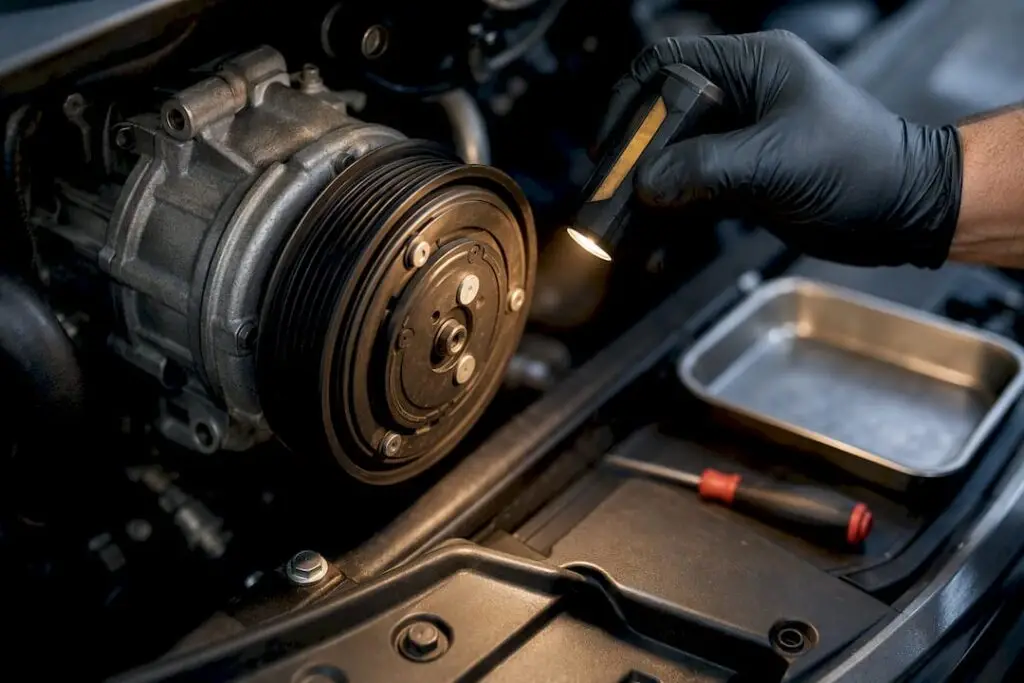
If your AC blows warm air, makes a grinding or squealing noise when the compressor kicks on, or you spot oily residue near the lines under the hood, the compressor is the prime suspect. Weak cooling, short cycling, a clutch that won’t engage, and a burning smell round out the classic warning signs. None of these guarantee compressor failure on their own, but together or in sequence, they usually mean the system needs a proper diagnosis before it gets worse.
TL;DR:
- AC compressor issues often stem from refrigerant leaks, contamination, or electrical faults, which cause symptoms like oily residue and odd noises.
- Diagnosing the exact failure type requires testing pressure, electrical systems, and checking for contamination, rather than relying solely on visible signs.
- Proper routine maintenance, such as leak repairs, system flushing, and replacing the receiver/drier, can significantly extend compressor life.
- Early warning signs like faint noises or slightly warmer vents should prompt professional diagnostics to prevent costly breakdowns.
- The typical lifespan of an AC compressor is 8 to 12 years, but neglect or leaks can shorten this significantly.
Table of Contents
- AC Compressor Symptoms: The Checklist to Run Through Now
- What Grinding, Squealing, and Clicking Noises Usually Mean
- Spotting AC Leaks, Odd Smells, and Other Visible Warning Signs
- Why AC Compressors Actually Fail
- When AC Compressor Failure Becomes a Safety Issue
- What a Shop Checks When You Bring In AC Compressor Symptoms
- Simple Maintenance That Extends Compressor Life
- A Shop’s View on Reading These Warning Signs Early
- Book AC Diagnostics Before a Small Symptom Becomes a Bigger Repair
- Sources
- FAQ
AC Compressor Symptoms: The Checklist to Run Through Now
Start with the symptoms that point most directly at the compressor, then work outward to the ones that could mean something else entirely.
- No cold air or weak cooling. The compressor pressurizes refrigerant so it can absorb heat from the cabin. When it can’t build pressure, the air coming through the vents feels lukewarm even at full blast.
- Short cycling or intermittent operation. The compressor clicks on, cools for a minute, then shuts off and repeats. This pattern often points to a failing clutch, a bad pressure switch, or low refrigerant tripping a safety cutoff.
- Unusual noises whenever the AC is running. Grinding, squealing, rattling, or clicking sounds tied specifically to AC use signal internal wear.
- Oily residue on fittings, hoses, or under the car. Refrigerant leaks tend to carry compressor oil with them, leaving a telltale film.
- The clutch won’t engage. No click, no vibration, no drop in idle when you switch the AC on.
- A burning smell from the vents or engine bay. Treat this one as urgent.
- Visible damage or vibration from the compressor housing. Cracks, rust, or a wobbling pulley usually mean the unit is already failing mechanically.
Reduced cooling can also come from low refrigerant, a clogged cabin filter, or a failing condenser, so a weak-air complaint alone isn’t a diagnosis. Smoke, burning smell, or a belt squeal followed by rising engine temperature are the ones that should move you off the “wait and see” plan.
What Grinding, Squealing, and Clicking Noises Usually Mean
Sound is one of the most useful clues you can hand a technician, because different noises point to different failure points inside the compressor.
- Grinding or metallic scraping usually means a worn internal bearing or damaged pistons inside the compressor body.
- A high-pitched squeal often traces back to belt slip or a clutch that’s engaging unevenly.
- Rattling or knocking suggests loose internal components, sometimes from metal debris circulating through the system.
- Clicking as the AC cycles on and off can be normal clutch engagement, or a sign the clutch itself is starting to fail.
You can do a basic visual check: with the engine running and AC on, look at the compressor pulley. If the outer pulley spins but the center clutch plate doesn’t lock in with it, that’s a disengagement problem worth flagging. Beyond that, owner-level checks hit their limit fast.
Pro Tip: Pull out your phone and record the sound the next time it happens, noting whether it’s at idle, while driving, or only after the AC has run a while. That detail alone can cut real diagnostic time once a technician has the car in the bay.
Spotting AC Leaks, Odd Smells, and Other Visible Warning Signs
A greasy sheen around hose fittings, the compressor shaft seal, or the receiver/drier almost always means refrigerant is escaping and taking lubricating oil with it. That oil loss is a bigger problem than the lost refrigerant itself, since a compressor running dry wears out fast.
- Musty smell from the vents points to moisture and mold on the evaporator core, not the compressor.
- Burning smell suggests a slipping belt, an overheating clutch, or electrical arcing, and warrants pulling over.
- Oily film on lines or under the car confirms a leak that recharging alone won’t fix.
Simply topping off refrigerant without finding and repairing the leak is a short-term patch at best. The system will lose charge again, and the compressor keeps running low on lubrication in the meantime.
Why AC Compressors Actually Fail
Most compressor failures trace back to a handful of root causes, and knowing which one applies changes what the repair actually needs to include.
- Low refrigerant or oil starvation is the most common trigger. Even a small leak accelerates internal wear once lubrication drops below what the moving parts need.
- Contamination, sometimes called “black death.” Moisture mixing with refrigerant and debris creates an acidic sludge that coats and damages internal components, often after a leak sat unrepaired too long.
- Overcharge, wrong oil type, or installation errors. A system serviced incorrectly, even once, can shorten a compressor’s remaining life dramatically.
- Electrical faults. A failing clutch coil, a bad pressure sensor, or wiring issues can stop the compressor from engaging even when the unit itself is mechanically fine.
- Age and normal wear. Most compressors last somewhere around 8 to 12 years or 60,000 to 100,000 miles, though contamination and neglected leaks routinely cut that shorter.
When AC Compressor Failure Becomes a Safety Issue
A compressor that seizes doesn’t just stop cooling. On many vehicles, it locks the serpentine belt in place, and that belt often also drives the water pump and alternator. Lock the compressor, and you can stall both.

Treat a sudden belt squeal followed by rising engine temperature, visible smoke, or a burning smell as reasons to stop driving. Turn the AC off immediately, and if you’re stuck without other options, running the heat can sometimes keep coolant circulating a bit longer. Get the vehicle to a shop rather than continuing the trip.
What a Shop Checks When You Bring In AC Compressor Symptoms
A proper diagnosis follows a set sequence, not guesswork, and it’s why shops rarely quote a firm price before looking at the car.
- Visual inspection of the compressor, lines, and fittings for oil residue, cracks, or corrosion.
- Pressure testing the high and low sides to see whether the system holds charge correctly.
- Dye and electronic leak detection to pinpoint exactly where refrigerant is escaping.
- Clutch electrical testing, checking the coil, wiring, and pressure switches that control engagement.
- Pulley spin and belt inspection, looking for bearing drag or belt wear tied to the compressor.
- Contamination check, since metal debris in the system usually means the condenser and expansion device need attention too, not just the compressor.
Depending on what those steps find, the repair might be a leak fix and recharge, a full compressor replacement, or a system flush when contamination has spread. Cost swings on vehicle make and model, how contaminated the system is, whether OEM or aftermarket parts fit the repair, and labor time, which is exactly why an accurate quote comes after diagnosis, not before it.
Simple Maintenance That Extends Compressor Life
A little routine attention goes a long way toward avoiding the failures above.
- Have leaks checked and repaired rather than just topping off refrigerant when cooling starts to fade.
- Ask for proper vacuum evacuation before any recharge, so moisture doesn’t get trapped in the system.
- Insist the receiver/drier gets replaced whenever the system is opened up for repair, and that refrigerant goes back in by weight with the correct oil type.
- Get the system checked at the first sign of weak cooling instead of waiting for total failure.
Pro Tip: DIY recharge kits from the auto parts store can mask a leak for a week or two, but they can’t diagnose contamination or clutch problems. If the symptoms come back within a season, that’s usually a sign the underlying issue never got fixed.
A Shop’s View on Reading These Warning Signs Early
Most compressor failures we see didn’t start as failures. They started as a faint noise, a slightly warmer vent, or a clutch that hesitated before engaging. Dealer-level diagnostics exist because those early signals are easy to dismiss and expensive to ignore once a seized compressor takes the belt with it.
Before your appointment, jot down when the symptom started, whether it’s constant or intermittent, and any sound recordings you’ve made. That handful of details, paired with proper pressure testing and electrical checks, gets you a clearer answer and a repair plan you can trust instead of a guess.
Book AC Diagnostics Before a Small Symptom Becomes a Bigger Repair
Alternative European & Domestic gives European, domestic, and high-performance vehicle owners dealer-level AC diagnostics without the dealer wait or the dealer markup guesswork. Where a quick-lube chain might just recharge the system and send you off, our approach traces the actual cause, whether that’s a leak, a failing clutch, or contamination working through the lines, so the repair holds.

If you’re hearing a new noise when the AC kicks on, noticing oily spots under the car, or the cabin just isn’t getting cold like it used to, don’t let it ride through another Texas summer. Schedule a diagnostic appointment with Alternative Car Care and get a straight answer on what’s actually happening under the hood, along with clear next steps before it turns into a roadside breakdown.
Sources
- 4 warning signs your car’s AC is about to die during a summer road trip — How-To Geek
- Top AC Compressor Failure Causes and How to Prevent Them — Rick’s Free Auto Repair Advice
- Diagnosing and Fixing Compressor Failures — ImportCar
- What Causes a Car AC Compressor to Fail? Signs, Costs & Engine Overheating Link — The Daily Automotive
FAQ
What’s the average cost to replace an AC compressor?
Cost depends heavily on the vehicle, whether contamination requires flushing other components, and whether OEM or aftermarket parts are used, which is why shops quote a price after diagnosis rather than a flat number upfront.
How do I know if my AC compressor clutch is bad?
If the compressor pulley spins but the center clutch plate never locks in when you switch the AC on, or you hear clicking without any change in cabin airflow, the clutch or its electrical control is a likely cause.
What is the average lifespan of an AC compressor?
Most AC compressors last roughly 8 to 12 years or between 60,000 and 100,000 miles, though leaks, contamination, and skipped maintenance can shorten that considerably.
Will my AC still work if the compressor is bad?
A failing compressor can still run intermittently or blow weak, warm air for a while, but a fully seized compressor stops the AC completely and risks locking the serpentine belt, which affects other engine systems.