
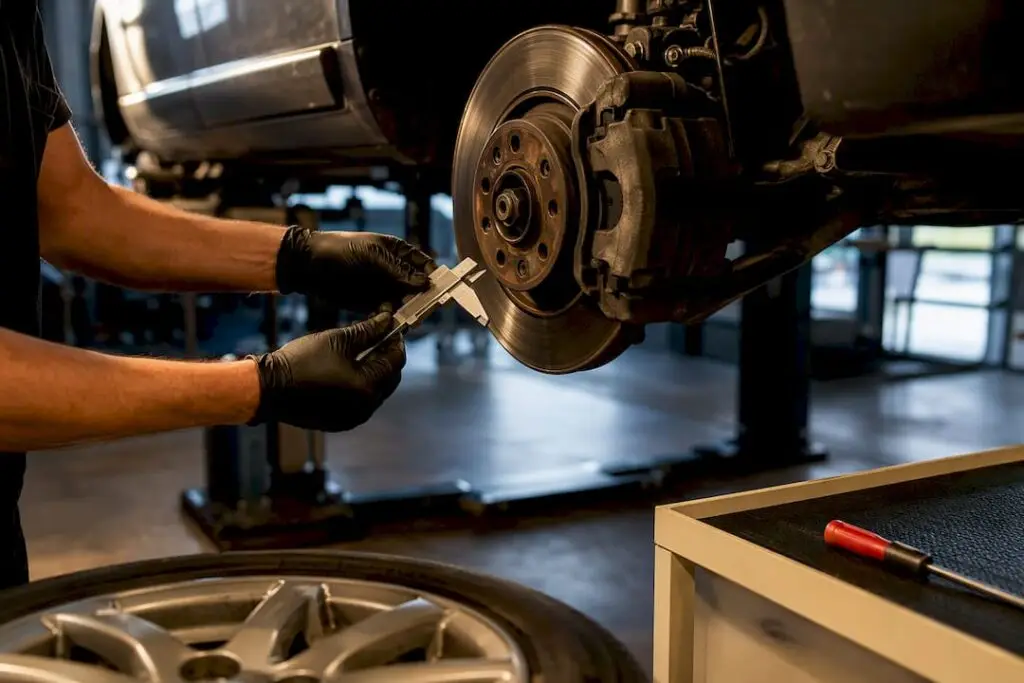
Expect to pay roughly $250 to $900 per axle for a standard Audi brake job in the United States, with pads-only work at independent shops on the low end and dealer pads-plus-rotor jobs pushing the high end. Independent shops typically run $250 to $600 per axle; dealerships often charge $400 to $900. The single biggest wildcard is whether your car needs new rotors, a sensor reset, or electronic parking brake work, since any of those can push a routine job well past $1,000.
TL;DR:
- Replacing rotors instead of resurfacing is standard on most Audi brake jobs, significantly increasing the overall cost.
- Upgrading to ceramic or performance pads and working on performance models can double or triple the typical brake repair expense.
- Electronic parking brake systems often require diagnostic scan tools and additional labor, adding unexpected costs to the job.
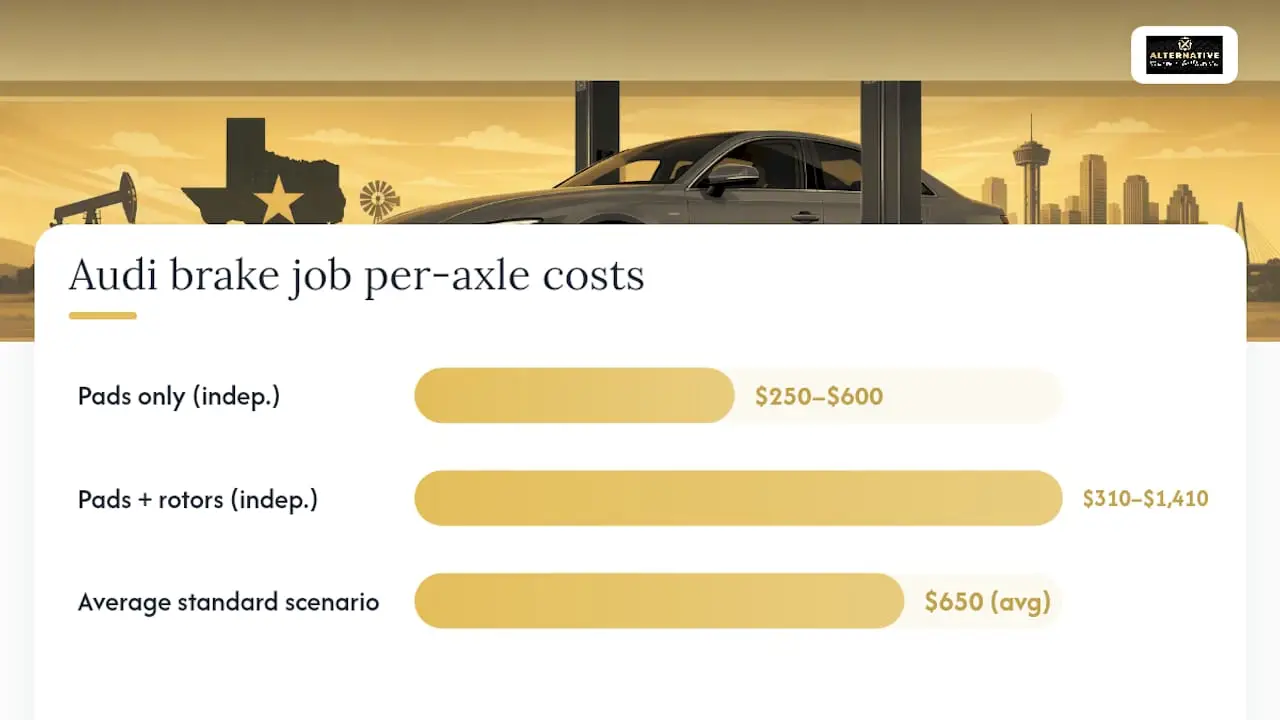
- Independent shops generally charge less than dealerships, with total costs for pads only ranging from $250 to $600, and full jobs averaging about $650 per axle.
- A detailed, written quote should specify parts, labor hours, diagnostic fees, and potential extra charges to prevent surprises on the final bill.
Table of Contents
- How Much Does an Audi Brake Job Cost by Service Type?
- What Drives the Cost of an Audi Brake System Repair?
- Is DIY Brake Work Worth It on an Audi?
- How Do You Get an Accurate Brake Job Quote?
- How We Handle Audi Brake Jobs at Alternative European & Domestic
- Get a Straight Answer on Your Audi’s Brake Estimate
- Sources
- FAQ
How Much Does an Audi Brake Job Cost by Service Type?
The Audi brake job cost splits cleanly into two tiers: pads only, and pads plus rotors. Pads-only jobs at an independent shop typically land between $250 and $600 per axle, according to pricing data compiled by Wheels Greed. Add new rotors and the math changes fast. Full pad-and-rotor jobs commonly range from about $310 to $1,410 per axle depending on parts quality and labor, with average scenarios clustering near $650 per axle for standard parts, based on data from Cost Insider.
Labor is baked into those numbers, and it matters more than most owners assume. Front axle labor typically runs 1.5 to 3 hours, rear axle jobs usually take 1.5 to 2 hours, and dealership labor time tends to stretch longer than independent shops on the same job, per the same Cost Insider breakdown.
Vehicle class shifts the whole range up or down:
- Compact models (A3, A4, Q3): generally sit at the lower end of the spectrum for both pads and rotors.
- Mid-size and full-size models (Q5, Q7, A6, A8): larger rotors and calipers push costs toward the middle to upper end of the ranges.
- S and RS performance variants: bigger brakes, denser pad compounds, and in some cases carbon-ceramic rotors can multiply the total well beyond a standard sedan job, according to model breakdowns from Europarts360.
| Service Type | Independent Shop (per axle) | Dealership (per axle) |
|---|---|---|
| Pads only | $250–$600 | $400–$900 |
| Pads + rotors | $310–$1,410 (standard tier) | $650–$1,410 (higher tier) |
Those numbers assume a compact or mid-size Audi with standard steel rotors and OE-equivalent pads. RS models with carbon-ceramic hardware typically cost significantly more, with no standard flat pricing applicable.
What Drives the Cost of an Audi Brake System Repair?
Four things move an estimate more than anything else: whether rotors get replaced, what pad material you choose, whether sensors or the electronic parking brake need attention, and what your local shop charges per hour.
Rotor replacement is now the default on most Audi brake jobs, not the exception. Many shops have stopped resurfacing rotors on modern vehicles altogether, since turning a rotor down can cause vibration and uneven pad wear that brings the car back in a few months, according to guidance from O’Reilly Auto Parts. That shift toward full replacement is a big part of why pad-and-rotor totals sit so much higher than pads-only jobs.
Pad material adds another layer. Standard semi-metallic pads sit at the bottom of the price scale. Ceramic pads run higher but wear more evenly and produce less brake dust. Performance-compound pads, common on S and RS trims, cost more still and sometimes need to be paired with matching rotor upgrades.
Sensors and the electronic parking brake (EPB) complicate things further:
- Brake wear sensors need replacement on many Audi models, not just reset, adding parts cost on top of labor.
- EPB-equipped rear brakes require a diagnostic tool to retract the caliper before pad removal, which some shops bill as a separate line item.
- Clearing the wear warning after the job often needs a scan tool like VCDS or OBDeleven, not just a reset button.
One data point worth remembering when you’re staring at a quote: pad-and-rotor totals for a standard Audi commonly land near $650 per axle on average, so anything wildly above or below that deserves a second look.
Pro Tip: Ask the shop straight out whether your labor quote already includes the EPB retraction and code clear. That’s the line item most likely to show up as a surprise on the final bill.
Is DIY Brake Work Worth It on an Audi?
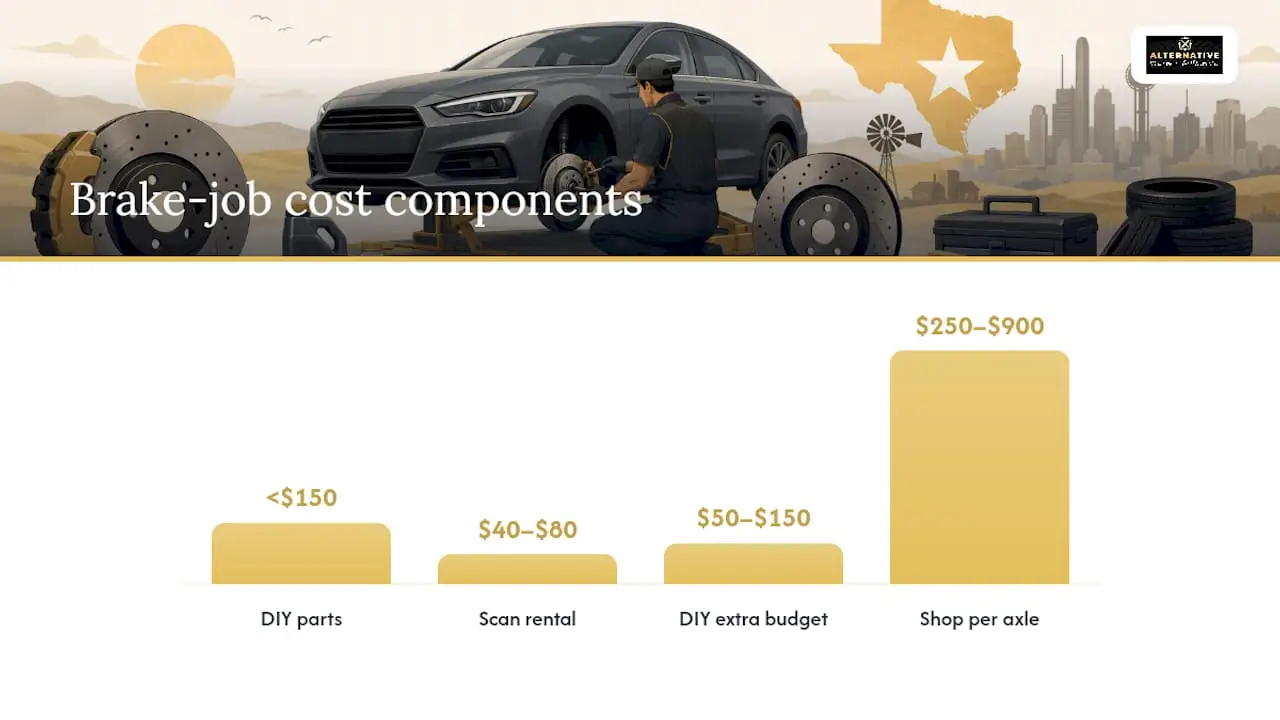
DIY pads can cost a fraction of a shop job on paper, sometimes under $150 in parts for a compact Audi. The catch is the tool you don’t already own. Most Audi models need a scan tool to retract the EPB caliper and clear the wear warning, and forum reports consistently show owners paying $40 to $80 to rent or borrow a VCDS or OBDeleven, or paying a shop for a quick reset visit, according to discussions on AudiWorld. That single step often erases most of the DIY savings.
A few practical guardrails:
- Pads-only jobs on non-EPB, non-performance models (older A3/A4 without electronic parking brakes) are reasonable DIY territory if you already own a torque wrench and a C-clamp.
- Anything involving rotor replacement, EPB calipers, or an RS-tier brake system is better left to a shop with the right lift and scan tools.
- Shops generally won’t resurface a rotor you bring in loose, both for liability and because resurfacing is falling out of favor industry-wide.
Pro Tip: If you’re set on DIY, budget an extra $50 to $150 beyond parts for the diagnostic scan or reset visit. Treat it as a line item, not an afterthought.
How Do You Get an Accurate Brake Job Quote?
A written estimate should answer five questions before you agree to anything. Skipping this step is how a $400 quote turns into a $650 invoice.
- Ask what parts are quoted. OEM, OEM-equivalent, or aftermarket, and whether rotors are included or being resurfaced.
- Ask for labor hours, not just a labor total. A quote of “2 hours at $150/hour” lets you compare shops directly; a flat “$300 labor” doesn’t.
- Ask about the diagnostic or scan fee. Confirm whether EPB retraction and code-clearing are already folded into labor or billed separately.
- Ask about warranty terms. Parts and labor warranties vary widely between independent shops and dealerships.
- Ask about disposal fees. Old pads and rotors often carry a small environmental disposal charge that shows up at checkout, not on the initial quote.
Once you have those numbers, the math is simple: labor hours multiplied by the shop’s hourly rate, plus parts, plus any diagnostic or disposal fees, equals your real total. Hidden fees commonly missed on Audi brake invoices include ABS sensor charges, EPB service surcharges, and premium-part upcharges, according to a cost breakdown from Cost Insider.
Watch for these red flags on a quote:
- Vague labor hours with no breakdown by axle
- No mention of hardware (clips, shims, sensors) despite a “complete” brake job claim
- A total well below the ranges above with no explanation of parts grade
How We Handle Audi Brake Jobs at Alternative European & Domestic
When an Audi comes into our Texas shop for brakes, we start with dealer-level diagnostics, not a visual guess. That means scanning for the actual wear-sensor status and EPB fault codes before we quote a single number, so you’re not paying for guesswork.
We’re upfront about parts choices. If OEM-equivalent pads make more sense than dealer-branded parts for your budget, we say so, and that choice shows up clearly on your written estimate, not buried in a lump-sum total. We also flag the extras up front, including sensor replacement, EPB retraction, and any rotor work, so the number we quote is the number you pay. Bring your service history if you have it. It helps us confirm whether your rotors are due for replacement or still within spec.
Get a Straight Answer on Your Audi’s Brake Estimate
The pricing breakdowns above give you a range. What they can’t tell you is what your specific Audi needs, and that’s where a lot of quotes go sideways, especially on EPB-equipped models where a missed diagnostic step turns into a surprise line item later. Alternative European & Domestic runs dealer-level diagnostics on every Audi that comes through the door, so the rotor, sensor, and EPB questions get answered before you commit to a number.
Our written estimates spell out parts brand, labor hours, and any diagnostic fees up front, so you can compare our quote against a dealer or another independent shop line by line. That transparency is the whole point of working with a specialist shop instead of guessing over the phone. If your Audi’s brake warning is on, or you just want a real number instead of a ballpark, schedule a brake inspection with Alternative European & Domestic and get a written quote before any work starts.
Sources
- Audi Brake Pad Replacement: Cost, Symptoms, and DIY Guide – Wheels Greed-All About Cars
- Audi Brakes and Rotors Cost 2026 – Cost Insider
- Audi Brake Pad Replacement Cost 2026: A4, Q5, Q7 & RS Models – Europarts360
- Brake drum & rotor resurfacing – O’Reilly Auto Parts store services
FAQ
How much does a full Audi brake job cost?
A full pad-and-rotor job on one axle typically runs $310 to $1,410 depending on parts and labor, with most standard jobs landing near $650 per axle at independent shops, according to Cost Insider.
Is it cheaper to get Audi brakes done at a dealer or independent shop?
Independent shops are usually cheaper, charging $250 to $600 per axle for pads compared to $400 to $900 at dealerships, per data from Wheels Greed.
Why do Audi brake jobs often cost more than expected?
Rotor replacement, brake wear sensors, and electronic parking brake (EPB) service are the usual culprits, since each adds parts or diagnostic labor that a simple pads-only quote doesn’t include.
Can I replace Audi brake pads myself to save money?
You can on non-EPB models with basic tools, but budget an extra $40 to $80 for the scan tool needed to reset the wear sensor, which often narrows the savings compared to a shop visit.
Do S and RS Audi models cost more for brakes?
Yes. Larger rotors, denser pad compounds, and in some cases carbon-ceramic hardware push S and RS brake jobs well above standard model pricing, per model comparisons from Europarts360.